Showing posts with label poems. Show all posts

Monday, 10 August 2015

Blue Moon Postlude


I am aware that I have countless posts on this blog about the moon. But what's one more eh? Especially since we have just experienced a blue moon last week.  That's right, a rare blue moon. It must be its bright pendulum that is still swaying my thoughts at the moment to all things lunar.   

The moon of course is a poet's most beloved muse. Muse and mentor. Metaphor-maker and talisman. A currency. A lightbulb of inspiration.  An occupational heart-ed object. A slice of sky on which all hopes and dreams get pinned, poetic preambulations plotted. The moon pulls the words in us like it does the tides: back and forth, to and fro, skimming and flooding the blank page of the mind. Our luminous patroness. 

The moon, as I've mentioned in other blogs (you can access them by clicking on the 'moon' label below this post') is something special to poets. We, supposedly, write by the light of the moon. This may not be true literally, but it holds metaphorically. Its luminescence is our light by which we 'see' things, its steady orbit of earth our mind in its forever watchful pose. 

If you are a poet, it's a surefire bet you've written one or two poems about the moon, if not a truckload. I know I have. The moon in all its manifestations: new moon, half moon, full moon, dark of the moon, harvest moon, pink moon, blue moon. And indeed, by the light of the moon - of which I mean at night, bathed in the glow of its unobtrusive light. 


The moon offers countless imaginings to poets: it can be a female deity (this is especially true for many female poets' poems - Carol Ann Duffy's 'Woman in the Moon' is a highlight as is Anne Sexton's 'Moon Song, Moon Woman'; Alice Oswald also has a few great feminine odes to the moon), a disco ball, a disembodied person, a source of romance, of mysticism, of inspiration, of myth vs reality, of ever-constant guardian or silent witness. There are poems in which the moon speaks or in which the poet addresses the moon like an old friend, a romantic overseer. I particularly love Carl Sandburg's 'Backyard' poem in this respect, it's so jubilant and full of the notion of romantic celebration/transformation.  And Billy Collins' 'The Man in the Moon' has such an endearing quality to it. It describes so nonchalantly the moon's ever-there presence in a poet's life, moving through extremes of emotion for that grand ending which also expresses the poet's own unbridled joy at the sight of the moon.

Poems in which the moon is mused upon from a scientific perspective (Archibald Mac Leish's 'Voyage to the Moon' was an imaginative inquisitve response to the 1969 landings; May Swenson  also does a great one on this topic, of which I've posted here before in a previous blog so won't again), a romantic enchantment, or most often a luminously inspired state, even, a lonely solitary one.  Loneliness and the moon are so often intertwined, the moon has come to stand as a symbol of the state, a talisman, a globed sigh hung in the night sky. But it also seems to represent beauty through solitude - a lonely, but beautiful presence. Sara Teasdale's short poem on this 'Morning Song' is gorgeous and offsets loneliness and sadness so beautifully with the idea of solitude, of independent freedom of mind and body, it is one of my favourites for sure. Or the last poem I've posted here, a concrete poem on the moon, pokes fun at all the descriptions heaped on the moon, but then ends on a simple, short almost whispered confession of one truth - the loneliness of the moon.

For some, the moon is light, proof of life beyond our earth, and to others it is the light of the mind, the illumination within when inspiration strikes. I adore Mark Strand's musing on it, 'Open the book of evening to the page/where the moon, always the moon appears...'  Or Kojiju's ode proposing that even to know that the moon exists is to be certain of light not only in night, but in the uncertainty of our universe, in the darkest mysteries of life and what lies beyond.


The moon as it appears in poetry can be magic, can be balm,  or just mystery. A constant companion or an aloof indifferent onlooker, sometimes an advocate for lunacy.  Always though, it is a charm, which exerts an undeniable and sometimes inexplicable power on the poet and the reader.  I cannot get enough of moon poetry - writing and reading it. I search out poems on the moon with something of an explorer's gleeful momentum. Every time I find a new one, it is like the moon has been rediscovered - it is new and gleaming once again. Moon poems shine with a light that comes from awed observance and perceptive finely-tuned poetic antennae.

It seems every poet has written at least one ode to it. Some seem truly smitten, the likes of: Carl Sandburg, Emily Dickinson, Billy Collins, Mark Strand, Alice Oswald, Ted Hughes, Sylvia Plath, WH Auden.  I want to post a few of those poems here today, a few of my my favourites, poems that I have not already posted here.  I hope you will enjoy them and feel moved to suggest some of your favourite moon poems? 

Happy Blue Moon Musing, 

~Siobhán 

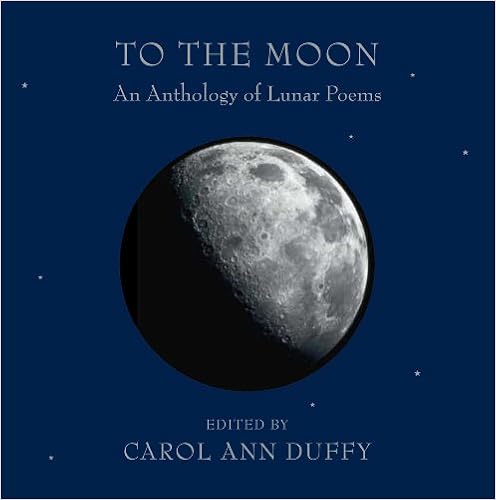
*Most of these poems are taken from this wonderful anthology: 


On the Spirit of the Heart as Moon-Disk - Kojiju

Merely to know
The Flawless Moon dwells pure
In the human heart
Is to find the Darkness of the night
Vanished under clearing skies.


The Man in the Moon - Billy Collins

He used to frighten me in the nights
of childhood,
the wide adult face, enormous, stern, aloft
I could not imagine such loneliness, such coldness
But tonight as I drive home over
these hilly roads
I see him sinking behind stands of winter trees
And rising again to show his familiar face
And when he comes into full view
over open fields
he looks like a young man who has fallen in love
with the dark earth
a pale bachelor, well-groomed and
full of melancholy
his round mouth open
as if he had just broken into song.


***


Moon - Mark Strand

Open the book of evening to the page
where the moon, always the moon appears
between two clouds, moving so slowly that hours
will seem to have passed before you reach the next page

where the moon, now brighter, lowers a path
to lead you away from what you have known

into those places where what you had wished for happens,
its lone syllable like a sentence poised

at the edge of sense, waiting for you to say its name
once more as you lift your eyes from the page

close the book, still feeling what it was like
to dwell in that light, that sudden paradise of sound.


***


Moon Compasses - Robert Frost

I stole forth dimly in the dripping pause
Between two downpours to see what there was.
And a masked moon had spread down compass rays
To a cone mountian in the midnight haze, 
As if the final estimate were hers;
And as it measured in her calipers, 
The mountain stood exalted in its place.
So love will take between the hands a face... 

***

The Well - Denise Levertov

At sixteen I believed the moonlight
could change me if it would.
          I moved my head
on the pillow, even moved my bed
as the moon slowly
crossed the open lattice.

I wanted beauty, a dangerous
gleam of steel, my body thinner,
my pale face paler.
          I moonbathed
diligently, as others sunbathe.
But the moon's unsmiling stare
kept me awake. Mornings,
I was flushed and cross.

It was on dark nights of deep sleep
that I dreamed the most, sunk in the well,
and woke rested, and if not beautiful,
filled with some other power. 


Moon Song, Woman Song - Anne Sexton

I am alive at night.
I am dead in the morning,
an old vessel who used up her oil,
bleak and pale boned.
No miracle. No dazzle.
I’m out of repair
but you are tall in your battle dress
and I must arrange for your journey.
I was always a virgin,
old and pitted.
Before the world was, I was.
I have been oranging and fat,
carrot colored, gaped at,
allowed my cracked o’s to drop on the sea
near Venice and Mombasa.
Over Maine I have rested.
I have fallen like a jet into the Pacific.
I have committed perjury over Japan.
I have dangled my pendulum,
my fat bag, gold, gold,
blinkedly light
over you all.
So if you must inquire, do so.
After all I am not artificial.
I looked long upon you,
love-bellied and empty,
flipping my endless display
for you, you my cold, cold
coverall man.
You need only request
and I will grant it.
It is virtually guaranteed
that you will walk into me like a barracks.
So come cruising, come cruising,
you of the blast off,
you of the bastion,
you of the scheme.
I will shut my fat eye down,
headquarters of an area,
house of a dream.


Voyage to the Moon - Archibald MacLeish 

Presence among us.                                      

                   Wanderer in our skies,


dazzle of silver in our leaves and on our
waters silver,
                      O
Silver evasion in our farthest thought –
“the visiting moon” . . . “the glimpses of the moon”...
and we have touched you!
                                           From the first of time,
before the first of time, before the
first men tasted time, we thought of you.
You were a wonder to us, unattainable,
a longing past the reach of longing,
a light beyond our light, our lives – perhaps
a meaning to us . . .
                                  Now
our hands have touched you in your depth of night.
Three days and three nights we journeyed,
steered by farthest stars, climbed outward,
crossed the invisible tide-rip where the floating dust
falls one way or the other in the void between,
followed that other down, encountered
cold, faced death – unfathomable emptiness . . .
Then, the fourth day evening, we descended,
made fast, set foot at dawn upon your beaches,
sifted between our fingers your cold sand.
We stand here in the dusk, the cold, the silence . . .
and here, as at the first of time, we lift our heads.
Over us, more beautiful than the moon, a
moon, a wonder to us, unattainable,
a longing past the reach of longing,
a light beyond our light, our lives – perhaps
a meaning to us . . .
                     O, a meaning!
over us on these silent beaches the bright
earth,


          presence among us.


***


Morning Song - Sara Teasdale

A diamond of a morning 
Waked me an hour too soon;
Dawn had taken in the stars 
And left the faint white moon. 

O white moon, you are lonely, 
It is the same with me,
But we have the world to roam over, 
Only the lonely are free. 


Backyard - Carl Sandburg

Shine on, O moon of summer.
Shine to the leaves of grass, catalpa and oak,
All silver under your rain to-night.

An Italian boy is sending songs to you to-night from an accordion.
A Polish boy is out with his best girl; they marry next month; to-night they are throwing you kisses.

An old man next door is dreaming over a sheen that sits in a cherry tree in his back yard.

The clocks say I must go—I stay here sitting on the back porch drinking white thoughts you rain down.

Shine on, O moon,
Shake out more and more silver changes.
 

'The Moon Speaks' - James Carter


How much it must bear on its back,
a great ball of blue shadow,
yet somehow it shines, keeps up
an appearance. For hours tonight,
I walk beneath it, learning.
I want to be better at carrying sorrow.
If my face is a mask, formed over
the shadows that fill me,
may I smile on the world like the moon.
- See more at: http://blog.sevenponds.com/the-next-chapter/dealing-with-grief#sthash.YYPw94l7.dpu
How much it must bear on its back,
a great ball of blue shadow,
yet somehow it shines, keeps up
an appearance. For hours tonight,
I walk beneath it, learning.
I want to be better at carrying sorrow.
If my face is a mask, formed over
the shadows that fill me,
may I smile on the world like the moon.
- See more at: http://blog.sevenponds.com/the-next-chapter/dealing-with-grief#sthash.YYPw94l7.dpuf

Monday, 15 June 2015

Yeats 2015: Lines to Remember


Here in Ireland we're in the midst of a Yeats frenzy. This year sees the celebration of our esteemed national poet's 150th birthday (13 June) and a series of events and publications to mark the occasion. (You can check out the content with the hashtag #Yeats2015)

Yeats is our great national poet, the poet responsible for the forging of the national character in letters. We owe him a great deal. Yeats the smiling public man, Yeats the learned man, the politician, the arts and culture activist who was involved in the Anglo-Irish Literary movement and more, who campaigned for the place of the arts in our new national consciousness, Yeats the Nobel-Prize winning poet whose skill sharpened as the years went on, Yeats the lovelorn suitor forever in love with Maud Gonne, his greatest muse, his unrequited love, Yeats the dreamer, the romantic, the believer in fairies and magic. I like this last persona of him best I think. The story of how his neighbours in Sligo would see him out walking, muttering away to himself, 'talking to himself' as they put it, or 'away with the fairies', as locals were wont to say, is one I always think of first when I think of Yeats. Of course as every poet knows, he must have been only testing his lines, trying out their rhythm, measuring and moving the words until they were pitch perfect. A man whose profession was a projection of who he was, and vice versa.

Truthfully, I must admit that Yeats wouldn't be one of my favourite poets.  I admire him greatly, but a lot of his poems for me seem either too coded what with all the allegories and references both classical and mystical, or, too vague. (It was with a certain degree of glee alright that I debunked his rural idyll construct in an essay once, preferring the realists of contemporary writers.) But I do love his language. All the lyrical ardor of it. And I love his romanticism ,even if it is misplaced at times. I especially love the descriptive word 'Yeatsian' for all that it implies: the dreamy, romantic, magical, lyrical world in which his poems are set and scripted, the lyrical, finely-wrought verse that pleases the eye as well as the ear, the heart as well as the head.

I find that I love specific lines from his poems more than the entire poems themselves. I couldn't really name you a favourite poem of his (there's a few that wrestle for attention), but I could joyfully recite many favourite lines like: "Come away oh human child, to the waters and the wilds, for the worlds's more full of weeping than you can understand," or the beautiful and evocative "the silver apples of the moon, the golden apples of the sun," or that dramatic tragic declarative refrain of Easter 1916: "All changed,changed utterly, a terrible beauty is born." In all historical accounts of the 1916 Easter Rising I've read, nothing has so effectively summed it up as those terse lines.


I love Yeats's lines as they are so condensed: so much is said in so short a space and said so eloquently. They are resplendent with deep reverie. Feelings, theories, politics, lessons are mashed down into a compact pulp that carries all the meaning of the poem, and can relay a lengthy thesis into a bite-size caption, one that will stick in the head and heart. Truths are coined and contained in the concrete of his sentences: 'The best lack all conviction, while the worst are full of passionate intensity' from 'The Second Coming' is a simple way of explaining the complex problems inherent at the heart of all world crises. Yeats has so many of these lines and it is them that I think of when I think of Yeats' poetry.  Lines that lap on the shores of my mind with syncopated loveliness. Lines that  rhyme just enough to be easily remembered.  Lines that soothe and swoon. Lines that shine the bright light of epiphany. Lines that demand recitation, that long to be spoken aloud, sounded on the breath. Lines that are like words from a spell, incantations of dreaminess. Lines as fragile as dew drops that loop an ethereal idea. Lines that are hearts ease. Lines that are stepping stones to a different plane of existence, that transform and transcend.

Yeats' lines are famous, not only on the tip of tongues but in popular culture too. Did you know that Cormac Mc Carthy's book (and the subsequent film) 'No Country  For Old Men' took its title inspiration from that very line in 'Sailing to Byzantium'? And that Spielberg's film 'A.I.' about artificial intelligence used the refrain from 'The Stolen Child' as a way of illustrating the young robot boy's wish to be human? And I remember once reading a book which took its whole premise and plot from the main character's remembrance of the poem 'The Song of Wandering Aengus'

For my marking of #Yeats 2015 here, I'm going to share some of these lines here. I hope you enjoy them and, if you feel so inclined to, share your experiences or favourite lines or poems of Yeats. 

~ Siobhán  


*WB Yeats at 150 The Irish Times Supplement


"I will arise and go now, and go to Innisfree...
And I shall have some peace there, for peace comes
dropping slow...
There midnight's all a glimmer, and noon a purple 
glow...
I hear it in the deep heart's core."
~The Lake Isle of Innisfree


"And pluck till time and times are done
The silver apples of the moon,
The golden apples of the sun."
~ 'The Song of Wandering Aengus'

"From our birthday, until we die,
Is but the winking of an eye;"
~'To Ireland in The Coming Times'

"A line will take us hours maybe;
Yet if it does not seem a moment's thought,
Our stitching and unstitching has been naught."
~'Adam's Curse'


"How can we know the dancer from the dance?"
~'Among School Children'


"The best lack all conviction, while the worst
are full of passionate intensity."
~'The Second Coming'


"Too long a sacrifice 
can make a stone of the heart."
~'Easter 1916'

"An aged man is but a paltry thing,
A tattered coat upon a stick, unless
soul clap its hands and sing, and louder sing..."
~'Sailing to Byzantium'

"Irish poets learn your trade,
Sing whatever is well made."
~ 'Under Ben Bulben'


"I shall have written him one
Poem maybe as cold
And passionate as the dawn."
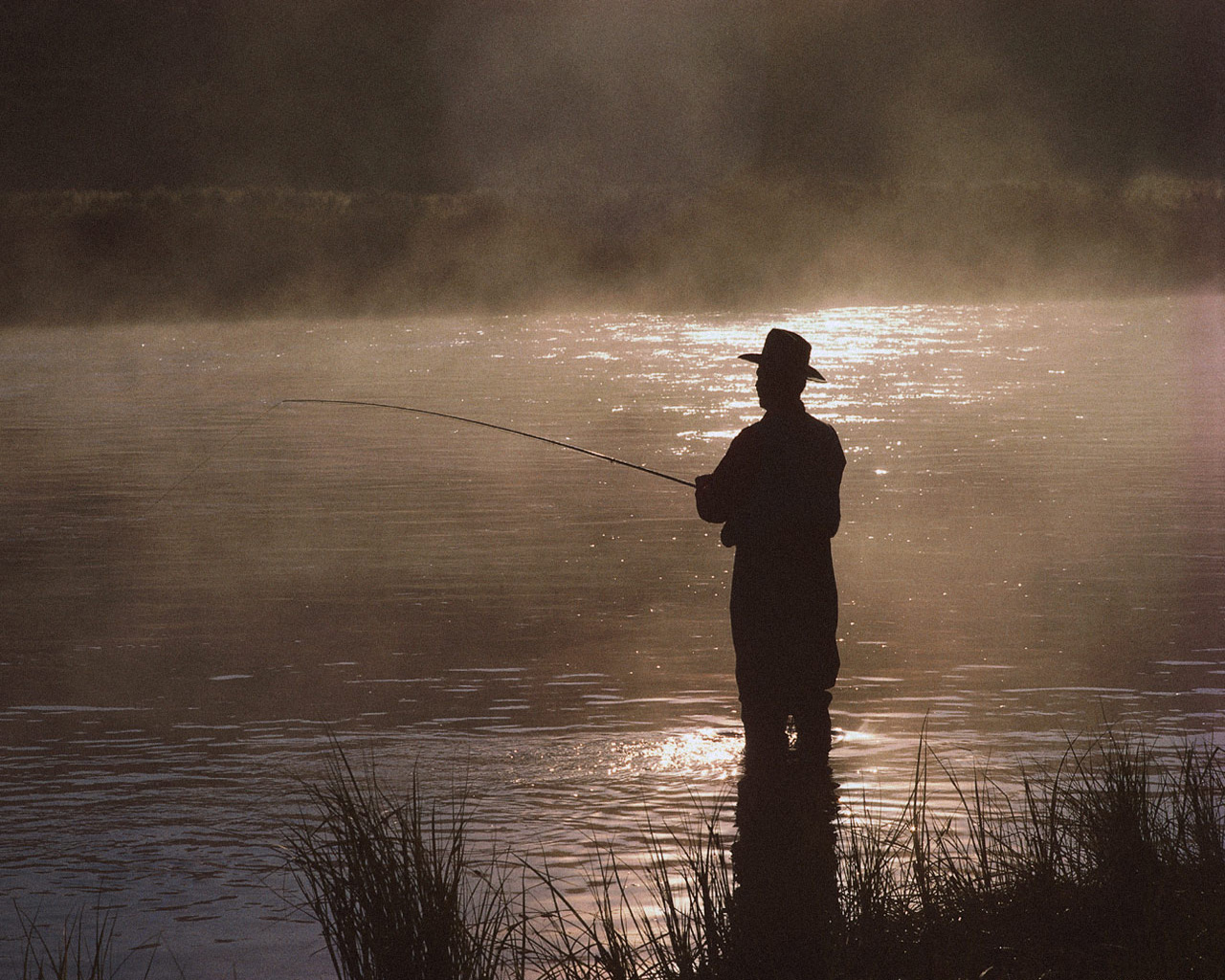
~'The Fisherman' 

"I must lie down where all ladders start
In the foul rag and bone shop of the heart."
~ 'The Circus Animals' Desertion'

"I have spread my dreams under your feet;
tread softly because you tread on my dreams."
~ 'He Wishes for the Cloths of Heaven'

"Out of the quarrel with others we make rhetoric, 
out of the quarrel with ourselves, 
we make poetry." 


Thursday, 7 May 2015

Pocket Poems for Poetry Day


Today is Poetry Day here in Ireland, an event created by Poetry Ireland to bring poetry to the attention of the nation.  One of the initiatives on the menu is 'pocket poems' - literally a pocket sized  poem to take with you and keep in your pocket. On Poetry Ireland's website there are a number of 'pocket' poems to choose from to download and/or distribute for the day. (You can see them here: Poetry Ireland Poetry Day

Pocket poems as a venture have been doing the rounds for a while in America. And I just love the idea of them. They make poetry so accessible. And personal. And keepsake-able. So I've decided to post some of my own choices of pocket poems here for you to enjoy (and even print out and keep, in your pocket if you like.) Poetry Ireland's pickings are slim, so I thought I'd add to them. I would love to distribute them, but don't really have the means or copyright licensing! But I fantasize about the day when poems are handed out as leaflets in the street to passers-by. Imagine! 

Because that's exactly the medium that poems excel in of course - one that can be carried around, in your pocket, casual, accessible. Words to smooth the rough road of routine. Words to remind you of what really matters. A sort of note-to-self with a wisdom agenda. A memo from the heart reminding us to stop and pay attention to life as it buzzes on around us. Poems that can be committed to memory to comfort and assure. Poems that are are short but say so much. Poems that will orbit us all day, little satellites of meaning, flashing neon insights of extraordinary alighting in the ordinary.

My choices here today are some of my favourite short poems. They have all three things in common: they are short, not just pocket-sized but maybe even palm-sized; they are simply rendered but laden with miniature life-lessons and reflections that I hope will bring a smile to your face; they are all products of attentiveness to the ordinary world around us and from that that awareness, offer advice and wisdom and surprise observation. In modern day lingo, we would maybe call it mindfulness. Perhaps poetry's greatest attribute and side-effect.  Try it :)


Happy Poetry Day! 


~ Siobhán 


*Join in Poetry Day on Twitter by tweeting your favourite poem with the hashtag #PoetryDayIrl or on Facebook & nominate 3 friends to share theirs :)


~ Billy Collins


~ Raymond Carver


~ May Sarton

~ Lawrence Ferlinghetti


~ Ted Kooser


~ Maya Angelou


Monday, 13 April 2015

Poems On Paintings (Repost*)


'The Poet' - Marc Chagall

*I'm reposting this post as it was recently featured in an art website: www.upandcomingart.co.uk of which I am really chuffed. I have added to the original post which appeared here a few years ago. It's such a fascinating subject! You can check out the link: here


'Painting is silent poetry and poetry is painting that speaks' Plutarch once said. Maybe that explains the interconnectedness of these two genres and why there have been so many poems written about paintings throughout the ages and of course, vice-versa, so many paintings inspired by poems.

As I write this I'm just back from a gallery visit, where I have spent a lot of time as a silent spectator, like most visitors, trying to glean what each painting has to say, trying to put words into its mouth so to speak. 

And I'm not the only one. I see that the gallery runs creative writing days where members of the public are invited to come in, notebooks in tow, pick a painting of choice and write about it. Sometimes there are workshops to direct this writing, sometimes it's just a solitary activity. I must admit I'm fascinated by the blending of these two artistic mediums, the putting a voice to the 'silence' of the paintings so to speak.

And I'm not the only one to feel like this. Many writers throughout the decades have taken inspiration from famous paintings and written poems as 'odes' to the painting, verbal narratives to the 'silent story', or penned philosophical and often personal musings on a piece of art dear to them. An 'ekphrastic' poem is the technical name for such a poem. The poet Alfred Corn states in his essay on the history of ekphrastic verse* (You can read more about ekphrastic poetry as a genre: here) that "once the ambition of producing a complete and accurate description is put aside, a poem can provide new aspects for a work of visual art."

Poetry on art does not seek to describe accurately what is there, but to add to the understanding of it. It does indeed provide new aspects for a work of art. It heightens our experience of it and adds dimensions that otherwise would have gone unnoticed. A veritable viewfinder.


'The Lady of Shalott' - John William Waterhouse

From as far back as Homer and Dante, there have been many famous examples of poems written specifically on paintings. As there is also many a painting that has had its origins in a poem, or even a line of a poem. John Waterhouse's painting 'The Lady of Shalott' is a representation of a scene from Tennyson's poem of the same name, as was his 'La Belle Dame Sans Merci', inspired by Keats' poem. Indeed there are many painters who have been described as 'poets' and poets who have been described as 'painters'. Marc Chagall and Dylan Thomas are two that spring to mind. And then of course, there are also poets who are painters too (William Blake for one), and painters who are also poets (none other than Michelangelo.) Poet Mark Strand went to the Yale School of Art and Architecture intending to become a painter, until he found poetry and switched to a different course.

It is safe to say that poets who write on art have an affection for it, some are even connoisseurs. It's not as if they're making a random imaginative leap in the dark but rather an informed meditation, even though feeling is foremost in it. Some poets like John Berryman even have had an extensive background in art - making his living as an art critic before becoming a poet. Edward Hirsch, poet and art enthuse, has collected poems and writings - what he calls 'imaginative acts of attention' - on the entire art collection of The Art Institute of Chicago in his book called 'Transforming Vision: Writers on Art'. (You can read the interesting introduction: here)

Book-TransformingVision-rev

Perhaps the most famous example of a poem written on a painting is WH Auden's meditation on Breughel's 'The Fall of Icarus'. It provides not only an accompanying narrative to the painting, but a powerful psychological and memorable commentary on human suffering too. Auden has used the painting as proof proper of how the world always goes indifferently on in regards to suffering and death:

 
         'The Fall of Icarus' - Breughel

Musee des Beaux Arts -W. H. Auden 

About suffering they were never wrong,
The old Masters: how well they understood
Its human position: how it takes place
While someone else is eating or opening a window or just walking dully along;
How, when the aged are reverently, passionately waiting
For the miraculous birth, there always must be
Children who did not specially want it to happen, skating
On a pond at the edge of the wood:
They never forgot
That even the dreadful martyrdom must run its course
Anyhow in a corner, some untidy spot
Where the dogs go on with their doggy life and the torturer's horse
Scratches its innocent behind on a tree.

In Breughel's Icarus, for instance: how everything turns away
Quite leisurely from the disaster; the ploughman may
Have heard the splash, the forsaken cry,
But for him it was not an important failure; the sun shone
As it had to on the white legs disappearing into the green
Water, and the expensive delicate ship that must have seen
Something amazing, a boy falling out of the sky,
Had somewhere to get to and sailed calmly on. 

This last line is a verbal echo of what we see in the painting. Auden has amplified the painting's meaning in his poem so much so that it seems almost necessary complementary reading.

American poet William Carlos Williams was a poet very much inspired by art. In fact he has written a whole volume of poetry on Breughel's paintings. He too has written a poem on 'The Fall of Icarus', a poem which in its very structure mimics the composition of the painting. In the painting, the fall of Icarus is not the focal point, it happens on the sidelines, as a footnote almost to the main picture. The mention of Icarus only in the very last line of the poem reflects this defining aspect of the  painting quite astutely:

Landscape With The Fall of Icarus - William Carlos Williams

According to Brueghel
when Icarus fell
it was spring


a farmer was ploughing
his field
the whole pageantry


of the year was
awake tingling
near


the edge of the sea
concerned
with itself


sweating in the sun
that melted
the wings’ wax


unsignificantly
off the coast
there was


a splash quite unnoticed
this was
Icarus drowning


Breughel seems to be a popular artist choice for poets. His 'Hunters in the Snow' painting has also garnered a lot of poetic responses. American poets John Berryman and Wallace Stevens have both written poems on it. (You can read them both here: The Poet Speaks of Art). 

Wallace Stevens was another American poet intensely interested in art. (See: 'The Problem of Painters and Poets' article here). His poem on Picasso's 'The Old Guitarist' is one that shows just how much of a muse a painting can be. It is quite lengthy so I won't post it all here, just an excerpt:


'The Old Guitarist' - Pablo Picasso

The Man With the Blue Guitar - Wallace Stevens
I
The man bent over his guitar,
A shearsman of sorts. The day was green

They said, "You have a blue guitar,
You do not play things as they are."

The man replied, "Things as they are
Are changed upon the blue guitar."

And they said then, "But play you must,
A tune beyond us, yet ourselves,

A tune upon the blue guitar
Of things exactly as they are...


In this poem the poet imagines the mind and voice of the figure in the painting and takes off from there into a vaulting imaginative meaning of the painting and philosophical reflection on life. Stevens applies a robust imaginative and intellectual take to the painting creating a world from it that can only be briefly glimpsed or guessed at by looking at it. Poems on paintings broaden the horizon for interpretation - reading them you feel your own synapses open up to just what exactly a painting can mean. It is not tethered to any boxed definition, but rather much like a poem, is wonderfully open to immersive speculation.

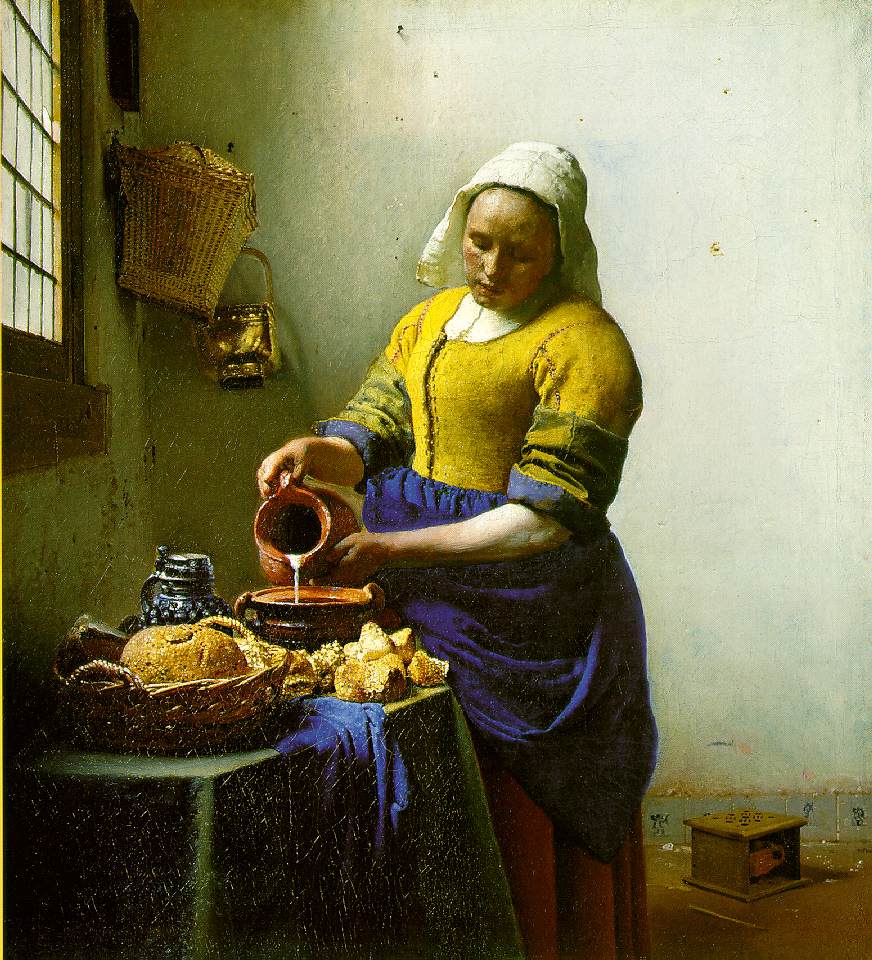
My favourite poems on paintings  are the ones that seem to say exactly and eloquently what the painting expresses visually. I love Wislawa Szymborska's short take on Vermeer's 'The Milkmaid.' Her quiet language simply but effectively states the grandeur of this painting, emphasizing the point of art's redeeming qualities. It is a poem that places so much importance on the place of art in our lives and one that invites a second look at the painting in question, not to mention a second awed and appreciative look at art in general:


'Vermeer' - Wislawa Szymborska

So long as that woman from the Rijksmuseum
in painted quiet and concentration
keeps pouring milk day after day
from the pitcher to the bowl
the World hasn’t earned
the world’s end.


Other poems on paintings are welcome translations of complex art. So many things can be read into abstract and modern art that it can be daunting. I love X.J. Kennedy's description of Marcel DuChamp's 'Nude Descending a Staircase.' It helps us see what is there and in such an entertaining way. The language is vivid and precise - 'she sifts in sunlight' - how accurate a description is that of what we visually see? And how about the perfectness of the word 'thresh' to describe the broken planes of lines in the picture?! For me, this poem brings the painting to life, so much so that I can see this 'one-woman waterfall' in flamboyant manner. The poem enlivens what we see with language that provides a 3D quality to the painting. It is a chant which brings its still self to buoyant life:


Nude Descending a Staircase - X. J. Kennedy 

Toe upon toe, a snowing flesh,
a gold of lemon, root and rind,
she sifts in sunlight down the stairs
with nothing on. Nor on her mind. 

We spy beneath the banister
a constant thresh of thigh on thigh--
her lips imprint the swinging air
that parts to let her parts go by. 

One-woman waterfall, she wears
her slow descent like a long cape
and pausing, on the final stair
collects her motions into shape.


Poets are well up to the task of providing worthy words to a visual masterpiece. Anne Sexton's 'Starry Starry Night', a poem on Van Gogh's famous painting of the same name, is another such example. The night 'boils with eleven stars', it is beast-like, a dragon. This poem is also indicative of how a painting can reflect a personal emotional state. How we can project on a work of art our feelings, and how a work of art can take on our feelings, a permeable acquiescent witness. This particular poem shows how one interpretation of a painting can be so unexpected and we may marvel at how different it may be from our own, the wonder of art reall:


The Starry Night - Anne Sexton


The town does not exist

except where one black-haired tree slips

up like a drowned woman into the hot sky.

The town is silent. The night boils with eleven stars.   

Oh starry starry night! This is how

I want to die.


It moves. They are all alive.

Even the moon bulges in its orange irons   

to push children, like a god, from its eye.

The old unseen serpent swallows up the stars.   

Oh starry starry night! This is how   

I want to die:


into that rushing beast of the night,   

sucked up by that great dragon, to split   

from my life with no flag,

no belly,

no cry.
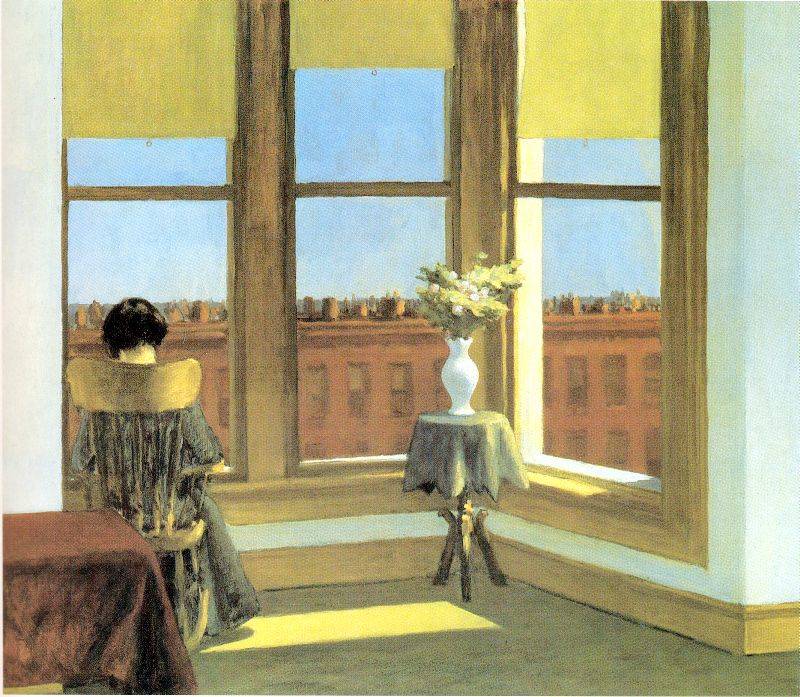
Have you ever seen a painting and wondered however you could express in words the image that accosted you, the light that was rendered so real, the colour that melted into your soul? One of my favourite poems on paintings takes an Edward Hopper painting as inspiration. Hopper of course, was a master at depicting light. The sunlight in his paintings is like a mirror-image, photographically precise, of the real thing. There is nothing else quite like it.  Just how to describe looking at it?! Even as a writer, I falter. But Anne Carson manages quite well in her poem on the painting 'Room in Brooklyn' to evoke its effect:

edward hopper room in brooklyn

Room in Brooklyn - Anne Carson

This
slow
day
moves
Along the room
I
hear
its
axles
go
A gradual dazzle
upon
the ceiling
Gives me that
racy
bluishyellow
feeling
As hours
blow
the wide
way
Down my afternoon. 


We wonder - what is this 'bluishyellow' feeling exactly? The feeling that is created in the painting of course. One lends expression to the other. Here, as with other poems on paintings, there is a perfect symbiosis state of being.

For me, poems written on paintings elucidate the painting that little bit more and bear witness to its 'silent story' that is etched out in colours and figures, brushstrokes and lines. For the casual art observer like me who often finds it hard to express what effect a painting has or to really peer into its soul, poetry is a helpful guide. Better than a gallery guide or catalogue, a poem can divulge a hidden story to the painting or hit on a personal meaning that resonates greatly with us, the viewer or reader - yes, that's exactly what this painting is about/makes me feel/is saying.  Now I get it!

In other words, a poem opens a secret door to let us into the painting. It draws our notice to the inherent stories woven there. Poems written on paintings offer the reader a verbal expression of the inexpressible feelings emanating from the artwork. They are explanation, realisation and intimation. In some cases they are welcome translation, and in others, imaginative transcendence. In every case, they are illumination. Some paintings I've never felt any great affection for I have looked at in a new light after reading a particular poem on them. In basic terms, poetry can be effective PR for a painting, and vice-versa. That symbiosis again.

What ekphrastic poetry does above all I think is demonstrate how a painting can be harboured so intimately in one's mind and heart. Essentially, how visual art is an ever arresting and affective medium. And how awe and affinity for it can be filtered not just via head-tilts and sighs and acquiring poster-prints, but in words.  For if words are indeed to be put to a painting, to speak its silent story, who better than a poet to do it? Art historians do it through fact and technique, poets do it through imagination.

Art and poetry may seem like two entirely different genres, but ekphrastic poetry begs to differ. Every art touches upon another and in doing so, broadens appreciation mutually. This has certainly been the case for me.

Below are some more poems on paintings to enjoy.
To read more poems on paintings click: here 


~ Siobhán


'Bedroom in Arles' - Vincent Van Gogh

Van Gogh's Bed - Jane Flanders

is orange,
like Cinderella's coach, like
the sun when he looked it
straight in the eye.

is narrow, he sleeps alone,
tossing between two pillows, 
while it carried him
bumpily to the ball.

is clumsy,
but friendly. A peasant
built the frame; and old wife beat
the mattress till it rose like meringue.

is empty,
morning light pours in
like wine, melody, fragrance,
the memory of happiness.


To Marc Chagall - Paul Éluard

Donkey or cow, cockerel or horse
On to the skin of a violin
A singing man a single bird
An agile dancer with his wife

A couple drenched in their youth

The gold of the grass lead of the sky
Separated by azure flames
Of the health-giving dew
The blood glitters the heart rings

A couple the first reflection

And in a cellar of snow
The opulent vine draws
A face with lunar lips
That never slept at night.


Number 1 - Jackson Pollock

DIGRESSION ON NUMBER 1, 1948 - Frank O' Hara

I am ill today but I am not
too ill. I am not ill at all.
It is a perfect day, warm
for winter, cold for fall.

A fine day for seeing. I see
ceramics, during lunch hour, by
Miro, and I see the sea by Leger;
light, complicated Metzingers
and a rude awakening by Brauner,
a little table by Picasso, pink.

I am tired today but I am not
too tired. I am not tired at all.
There is the Pollock, white, harm
will not fall, his perfect hand

and the many short voyages. They'll
never fence the silver range.
Stars are out and there is sea
enough beneath the glistening earth
to bear me toward the future
which is not so dark. I see.