Showing posts with label artists. Show all posts

Monday, 4 February 2013

Favourite Words #1: Melancholy


 'Melancholy is the pleasure of being sad.' - Victor Hugo

So I've come up with this idea for some new regular blog posts on some favourite words of mine (because I love what words can do). 

And the first word I'd like to muse on is: Melancholy. 

It's a word that often comes up in relation to poetry, poets, and the arts in general. And it's a word I love as much for its sound and its sight, as its meaning. 

 
Melancholy -  like a green vine coiling around the heart. Or a perfumed sadness. A beautiful kind of sorrow, like an intricate lace veil worn over the face while grieving, a deep forest-green pool of tears and an emerald halo of sighs. So many images that come to mind when I see the word... A black inkscape of tears, tears, so many tears, oval-shaped and drooping like sad but beautiful pearls.  

A dam of tears always on the verge of bursting. An eye, like an antenna, always open, and always feeling. (like The Cure's 'Wish' album artwork, left) And it sounds like tears too doesn't it? A collected deep reservoir of tears. And almost like the dripping of a tap that will never shut off - a faucet of tears left to over-run in the heart. Like the rippling of water in a pool after a stone is thrown in; a drowned wish.

When studying literature, melancholy is guaranteed to be one of the most common words you will come across in the experience of your reading. But what is melancholy exactly? And why and how did it originate? 

It's defined in the dictionary as being a 'deep, pensive, and long-lasting sadness.' The word 'melancholy' first arose from the medieval categorisation of the four medical 'humors' - diseases or ailments caused by an imbalance in the basic bodily fluids: melancholia, phlegmatic, sanguine and choleric. Melancholia was caused by an excess of black bile, a medical condition which had symptoms of moodiness, despair and sadness - hence the later terming of melancholy as a 'black' mood.

Shakespeare's Romeo & Juliet was the first place I encountered the word melancholy. Upon first seeing Romeo appear in the play, we learn from his cousin Benvolio that he is depressed, sad and moody, 'melancholy' as all the notes remark.  His father descibes his affliction in detail:
  'Many a morning hath he there been seen,
with tears augmenting the fresh morning's dew,
adding to clouds, more clouds with his deep sighs...
Away from light steals home my heavy son,
and private in his chamber pens himself,
shuts up his windows, locks fair daylight out,
and makes himself an artifical night:
Black and portentous must this humour prove,
unless good counsel may the cause remove.' 

'With tears augmenting the fresh morning's dew....' maybe that's where I got the tears imagery. Romeo is described in all the secondary reading as being 'melancholy' - sad for the sake of being sad, a sort of wallowing and feeling sorry for one's self, moody, in a word (which is brilliantly amplified by Radiohead's moody soundtrack in the Baz Luhrmann film version - listen here). Turns out, Romeo is lovesick and admits 'I have lost myself, I am not here, this is not Romeo, he's some other where.' A lovesick melancholy then. A sort of self-indulgent moping. A weight of weary woe.

The cult of melancholy was quite prevalent in Elizabethan society - stemming from a preoccupation with death and a lack of things to do for the educated classes. Shakespeare's Hamlet was a personification of this particular affliction, known as 'the melancholy Prince' or the 'malcontent', who spent his days philosophising and ruminating on death and existentialism, while battling with the horrors of revenge wrecked upon a sensitive mind. 

'There’s something in his soul,/O’er which his melancholy sits on brood;' - Claudius comments of him, while Hamlet himself spends most of the play moping around, contemplating the act of revenge upon his father's killer Claudius and indulging frequently in soliloquies which reveal the mechanisms of a mind prone to despair: 'I have of late, but wherefore I know not, lost all my mirth, forgone all custom of exercise; and indeed, it goes so heavily with my disposition that this goodly frame, the earth, seems to me a sterile promontory; this most excellent canopy, the air, look you, this brave o'erhanging firmament, this majestical roof fretted with golden fire: why, it appears no other thing to me than a foul and pestilent congregation of vapours.'

Eighteenth and nineteenth century England saw the further rise of melancholy. Poet John Keats' famous 'Ode to Melancholy' encapsulates this feeling, 'the wakeful anguish of the soul' perfectly. And like him, the Romantic poets fostered the cult of melancholy as an extension of the sublime and beauty. Because to suffer was to have a poetic sensibility, and in melancholy, beauty resided. French Modernist poet Charles Baudelaire noted 'I can barely conceive of a type of Beauty in which there is no melancholy'. Beauty was both the cause and cure of melancholy, as Keats demonstrates in this poem:

Ode on Melancholy - John Keats
1.
No, no! go not to Lethe, neither twist
Wolf's-bane, tight-rooted, for its poisonous wine;
Nor suffer thy pale forehead to be kissed
By nightshade, ruby grape of Proserpine;
Make not your rosary of yew-berries,
Nor let the beetle nor the death-moth be
Your mournful Psyche, nor the downy owl
A partner in your sorrow's mysteries;
For shade to shade will come too drowsily,
And drown the wakeful anguish of the soul.

2.
But when the melancholy fit shall fall
Sudden from heaven like a weeping cloud,
That fosters the droop-headed flowers all,
And hides the green hill in an April shroud;
Then glut thy sorrow on a morning rose,
Or on the rainbow of the salt sand-wave,
Or on the wealth of globed peonies;
Or if thy mistress some rich anger shows,
Emprison her soft hand, and let her rave,
And feed deep, deep upon her peerless eyes.

3.
She dwells with Beauty - Beauty that must die;
And Joy, whose hand is ever at his lips
Bidding adieu; and aching Pleasure nigh,
Turning to poison while the bee-mouth sips;
Ay, in the very temple of delight
Veiled Melancholy has her sovran shrine,
Though seen of none save him whose strenuous
tongue
Can burst Joy's grape against his palate fine;
His soul shall taste the sadness of her might,
And be among her cloudy trophies hung.

But in art, melancholy is something else: both an affliction and a gift. An expected consequence of being sensitive and creative.  Aristotle said that 'great men are always of a nature originally melancholy.'   
Artist Albert Durer represented melancholy as a state in which the artist waits for inspiration to strike; that time of despondency in between creative periods (Melancholia I, 1514, left). I can definitely relate to this as it's exactly how I have been feeling these past few days: forlorn and grey and withering away in the wake of impending inspiration as the world crashes into insignificance around me...

Melancholy became increasingly associated with artists and writers as the centuries wore on, a sort of occupational hazard almost. Claire Tomalin, Dickens biographer, has said that 'writing induces melancholy. You're alone, a hermit'-  which is quite true I suppose. And loneliness is a pre-requisite for melancholy. 

But also, melancholy seems an essential ingredient in creating great art too. How can you create great art without having known sadness? After all, it's the tragedies, the sad stories that get us the most, that stick in the gut and sputter in the heart. Singer-songwriter of The Beatles fame Paul McCartney said that with writers, 'there's nothing wrong with melancholy. It's an important colour in the writing.' This corresponds to what American singer-songwriter Shawn Colvin says about writing songs, 'I think that the indefinable space between happy and sad is the most moving and compelling place for an artist to be. If there's anything I consistently strive for, it's a melancholy limbo.' 

A melancholy limbo - a place between happy and sad. A moving and compelling place. Is that what melancholy can be defined as? From what I know of it, it is a limbo sort of place; a place you hang around in, full of shadows; a place where things are felt ever more keenly than normal and where everything seems bittersweet; and a place where your love of beauty is a symbolic pomegranate, condemning you to the dark underworld for a while. But all the better to see the light when you emerge again. 

Melancholy is not a word that you would hear in modern language. It's old-fashioned and sort of quaint sounding, but does it still exist? Yes. It's known now as the lighter side of depression, the medieval forerunner to it perhaps, but mostly, it's still a word associated with the arts and the artistic disposition. 

When I think of melancholy in a modern context I always think of 'Mellon Collie and the Infinite Sadness,' the aptly named album of nineties rock group The Smashing Pumpkins. Here is music that embodies the whole concept of the feeling, from the mournful artwork to the languorous tunes. It was an album 'based on the human condition of mortal sadness' according to the band's frontman Billy Corgan and features songs with lamentative titles like: 'Ode to No One, ' 'Tales of a Scorched Earth', 'By Starlight', ' 'Where Boys Fear to Tread, 'My Blue Heaven,' 'Porcelina of the Vast Oceans,' that echo the titles of those earlier Romantic poems which are just as doleful. (listen here)


Melancholy today manifests itself most in music, in sad songs most especially (and it sounds especially like this song: Lie in the Sound a lounging in moroseness, a sorrowful plunge, a drowning, a languor of lovesickness and lethargy, an innate ache, a free-falling into the empty echoing abyss of sadness.) And like in the Keats' poem, we do 'glut' ourselves on melancholy - it is a feeling mechanism if you like, a way and a means of actually feeling. We can shed tears from listening to the saddest songs. There's a grandeur about them that catches us around the throat. Maybe it's the catharsis - the release of pent-up emotions through art, that powerful process of emotional cleansing - that resonates with us so deeply.

Melancholy. Melancholy. Sad and sighs and sorrow and beauty and art and an aesthetic sensitivity. Victor Hugo may have been right - there is a pleasure in being sad - and that is what melancholy is. Not a dark despair, but a bittersweet appreciation of the sad things in life. As they are what can most make us feel.

And if melancholy is associated with art - a side-effect of it and an ingredient -  then art is also a cure for it. As writer and poet Margaret Atwood has said in no uncertain terms -  'the loony bins are full of those who haven't written a poem.' Maybe melancholy is our saving grace after all, not just a wistful characteristic. Something that involves both an appreciation of beauty as well as a wounding by it - in other words - an appropriate reaction to the world we find ourselves in.


~Siobhán 


Sunday, 22 July 2012

Solitude: A Writer's Privilege & Prerogative


Sometimes, I need to be alone. I need the solace of solitude when the world, in the words of Wordsworth, becomes 'too much with' me. 

My alone time is so important to me. It is the bedrock of my being. The foundations of my creativity. I need it to recharge and enhance my thinking and feeling and understanding ability. 

Without periods of solitude, I'd implode. I'd cease to be me. Especially after lots of time spent socially, I need the antidote of quiet time to recuperate and recover my self from the voices and influence of others. I need it to differentiate and consolidate the individual from the collective and find my bearings once again, as Virginia Woolf said, 'myself being myself.'

I can't go for any long lengths of time without this sacred time to myself. I'm sure this is true for all writers and creatives. How else would we create? Or germinate the seeds for creating? Like any seeds, they need dark and deep quiet.  

Just as Charles Bukowski says, solitude is as necessary to me as anything else, even more necessary than company. Without solitude, I wouldn't be a writer. In order to  write, you need to stand apart from the crowd to observe. Solitude is this observing space.

And I not only need solitude, I like it. I welcome it and revel in it! A free space where I can  spread my wings and know my wingspan. I relish time spent alone. Without it, I'd be a lesser less-known version of myself.

Well, I can't explain it any better than that. But just have a look at the collection of quotes below by many great artists and writers who truly knew the value of solitude.

enjoying my quiet time, 


~Siobhán


'Solitude'


"I have to be alone very often. I'd be quite happy if I spent from Saturday night until Monday morning alone in my apartment. That's how I refuel." - Audrey Hepburn

"I was a man who thrived on solitude; without it I was like another man without food or water. Each day without solitude weakened me. I took no pride in my solitude; but I was dependent on it. The darkness of the room was like sunlight to me.” ― Charles Bukowski

"If you're lonely when you're alone, you're in bad company.” ― Jean-Paul Sartre

 "I have never found a companion that was so companionable as solitude.” ― Henry David Thoreau

"If you are alone you belong entirely to yourself. If you are accompanied by even one companion you belong only half to yourself or even less in proportion to the thoughtlessness of his conduct and if you have more than one companion you will fall more deeply into the same plight.” ― Leonardo da Vinci 

"Loneliness is the poverty of self; solitude is richness of self.” ― May Sarton

 "A man can be himself only so long as he is alone; and if he does not love solitude, he will not love freedom; for it is only when he is alone that he is really free.” ― Arthur Schopenhauer

"I need solitude for my writing; not 'like a hermit' - that wouldn't be enough - but like a dead man.” ― Franz Kafka

"Language ... has created the word 'loneliness' to express the pain of being alone. And it has created the word 'solitude' to express the glory of being alone.” ― Paul Tillich

"Solitude is independence." - Hermann Hesse

"How much better is silence; the coffee cup, the table. How much better to sit by myself like the solitary sea-bird that opens its wings on the stake. Let me sit here for ever with bare things, this coffee cup, this knife, this fork, things in themselves, myself being myself.” ― Virginia Woolf,

 How can you hear your soul if everyone is talking?” ― Mary Doria Russell,

 Anything we fully do is an alone journey.” ― Natalie Goldberg

"Once more
Uncontradicting solitude
Supports me on its giant palm;
And like a sea-anemone
Or simple snail, there cautiously
Unfolds, emerges, what I am.” ― Philip Larkin

"I love the dark hours of my being.
My mind deepens into them.
There I can find, as in old letters,
the days of my life, already lived,
and held like a legend, and understood.” ― Rainer Maria Rilke

 "I never found the companion that was so companionable as solitude. We are for the most part more lonely when we go abroad among men than when we stay in our chambers.” ― Henry David Thoreau

"In solitude the passions feed upon the heart." - Edward G. Bulwer-Lytton

Wednesday, 25 April 2012

Poems On Paintings


'The Poet' - Marc Chagall
'Painting is silent poetry and poetry is painting that speaks' Plutarch once said. Maybe that explains the interconnectedness of these two genres and why there have been so many poems written about paintings throughout the ages and of course, vice-versa, so many paintings inspired by poems.

As I write this I'm just back from a gallery visit, where I have spent a lot of time as a silent spectator, like most visitors, trying to glean what each painting has to say, trying to put words into its mouth so to speak. 

And I'm not the only one. I see that the gallery runs creative writing days where members of the public are invited to come in, notebooks in tow, pick a painting of choice and write about it. Sometimes there are workshops to direct this writing, sometimes it's just a solitary activity. I must admit I'm fascinated by the blending of these two artistic mediums, the putting a voice to the 'silence' of the paintings so to speak.

And I'm not the only one to feel like this. Many writers throughout the decades have taken inspiration from famous paintings and written poems as 'odes' to the painting, verbal narratives to the 'silent story', or penned philosophical and often personal musings on a piece of art dear to them. An 'ekphrastic' poem is the technical name for such a poem. The poet Alfred Corn states in his essay on the history of ekphrastic verse* (You can read more about ekphrastic poetry as a genre: here) that "once the ambition of producing a complete and accurate description is put aside, a poem can provide new aspects for a work of visual art."

Poetry on art does not seek to describe accurately what is there, but to add to the understanding of it. It does indeed provide new aspects for a work of art. It heightens our experience of it and adds dimensions that otherwise would have gone unnoticed. A veritable viewfinder.


'The Lady of Shalott' - John William Waterhouse

From as far back as Homer and Dante, there have been many famous examples of poems written specifically on paintings. As there is also many a painting that has had its origins in a poem, or even a line of a poem. John Waterhouse's painting 'The Lady of Shalott' is a representation of a scene from Tennyson's poem of the same name, as was his 'La Belle Dame Sans Merci', inspired by Keats' poem. Indeed there are many painters who have been described as 'poets' and poets who have been described as 'painters'. Marc Chagall and Dylan Thomas are two that spring to mind. And then of course, there are also poets who are painters too (William Blake for one), and painters who are also poets (none other than Michelangelo.) Poet Mark Strand went to the Yale School of Art and Architecture intending to become a painter, until he found poetry and switched to a different course.

It is safe to say that poets who write on art have an affection for it, some are even connoisseurs. It's not as if they're making a random imaginative leap in the dark but rather an informed meditation, even though feeling is foremost in it. Some poets like John Berryman even have had an extensive background in art - making his living as an art critic before becoming a poet. Edward Hirsch, poet and art enthuse, has collected poems and writings - what he calls 'imaginative acts of attention' - on the entire art collection of The Art Institute of Chicago in his book called 'Transforming Vision: Writers on Art'. (You can read the interesting introduction: here)

Book-TransformingVision-rev

Perhaps the most famous example of a poem written on a painting is WH Auden's meditation on Breughel's 'The Fall of Icarus'. It provides not only an accompanying narrative to the painting, but a powerful psychological and memorable commentary on human suffering too. Auden has used the painting as proof proper of how the world always goes indifferently on in regards to suffering and death:

 
         'The Fall of Icarus' - Breughel

Musee des Beaux Arts -W. H. Auden 

About suffering they were never wrong,
The old Masters: how well they understood
Its human position: how it takes place
While someone else is eating or opening a window or just walking dully along;
How, when the aged are reverently, passionately waiting
For the miraculous birth, there always must be
Children who did not specially want it to happen, skating
On a pond at the edge of the wood:
They never forgot
That even the dreadful martyrdom must run its course
Anyhow in a corner, some untidy spot
Where the dogs go on with their doggy life and the torturer's horse
Scratches its innocent behind on a tree.

In Breughel's Icarus, for instance: how everything turns away
Quite leisurely from the disaster; the ploughman may
Have heard the splash, the forsaken cry,
But for him it was not an important failure; the sun shone
As it had to on the white legs disappearing into the green
Water, and the expensive delicate ship that must have seen
Something amazing, a boy falling out of the sky,
Had somewhere to get to and sailed calmly on. 

This last line is a verbal echo of what we see in the painting. Auden has amplified the painting's meaning in his poem so much so that it seems almost necessary complementary reading.

American poet William Carlos Williams was a poet very much inspired by art. In fact he has written a whole volume of poetry on Breughel's paintings. He too has written a poem on 'The Fall of Icarus', a poem which in its very structure mimics the composition of the painting. In the painting, the fall of Icarus is not the focal point, it happens on the sidelines, as a footnote almost to the main picture. The mention of Icarus only in the very last line of the poem reflects this defining aspect of the  painting quite astutely:

Landscape With The Fall of Icarus - William Carlos Williams

According to Brueghel
when Icarus fell
it was spring


a farmer was ploughing
his field
the whole pageantry


of the year was
awake tingling
near


the edge of the sea
concerned
with itself


sweating in the sun
that melted
the wings’ wax


unsignificantly
off the coast
there was


a splash quite unnoticed
this was
Icarus drowning


Breughel seems to be a popular artist choice for poets. His 'Hunters in the Snow' painting has also garnered a lot of poetic responses. American poets John Berryman and Wallace Stevens have both written poems on it. (You can read them both here: The Poet Speaks of Art). 

Wallace Stevens was another American poet intensely interested in art. (See: 'The Problem of Painters and Poets' article here). His poem on Picasso's 'The Old Guitarist' is one that shows just how much of a muse a painting can be. It is quite lengthy so I won't post it all here, just an excerpt:


'The Old Guitarist' - Pablo Picasso

The Man With the Blue Guitar - Wallace Stevens
I
The man bent over his guitar,
A shearsman of sorts. The day was green

They said, "You have a blue guitar,
You do not play things as they are."

The man replied, "Things as they are
Are changed upon the blue guitar."

And they said then, "But play you must,
A tune beyond us, yet ourselves,

A tune upon the blue guitar
Of things exactly as they are...


In this poem the poet imagines the mind and voice of the figure in the painting and takes off from there into a vaulting imaginative meaning of the painting and philosophical reflection on life. Stevens applies a robust imaginative and intellectual take to the painting creating a world from it that can only be briefly glimpsed or guessed at by looking at it. Poems on paintings broaden the horizon for interpretation - reading them you feel your own synapses open up to just what exactly a painting can mean. It is not tethered to any boxed definition, but rather much like a poem, is wonderfully open to immersive speculation.

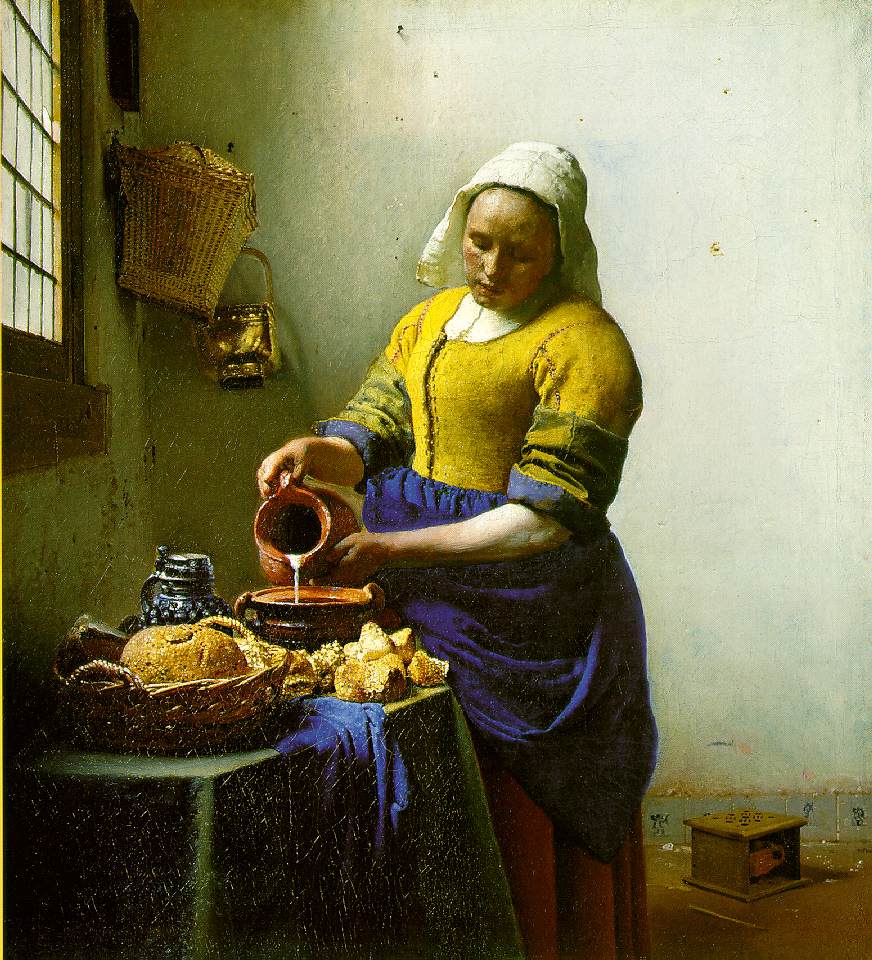
My favourite poems on paintings  are the ones that seem to say exactly and eloquently what the painting expresses visually. I love Wislawa Szymborska's short take on Vermeer's 'The Milkmaid.' Her quiet language simply but effectively states the grandeur of this painting, emphasizing the point of art's redeeming qualities. It is a poem that places so much importance on the place of art in our lives and one that invites a second look at the painting in question, not to mention a second awed and appreciative look at art in general:


'Vermeer' - Wislawa Szymborska

So long as that woman from the Rijksmuseum
in painted quiet and concentration
keeps pouring milk day after day
from the pitcher to the bowl
the World hasn’t earned
the world’s end.


Other poems on paintings are welcome translations of complex art. So many things can be read into abstract and modern art that it can be daunting. I love X.J. Kennedy's description of Marcel DuChamp's 'Nude Descending a Staircase.' It helps us see what is there and in such an entertaining way. The language is vivid and precise - 'she sifts in sunlight' - how accurate a description is that of what we visually see? And how about the perfectness of the word 'thresh' to describe the broken planes of lines in the picture?! For me, this poem brings the painting to life, so much so that I can see this 'one-woman waterfall' in flamboyant manner. The poem enlivens what we see with language that provides a 3D quality to the painting. It is a chant which brings its still self to buoyant life:


Nude Descending a Staircase - X. J. Kennedy 

Toe upon toe, a snowing flesh,
a gold of lemon, root and rind,
she sifts in sunlight down the stairs
with nothing on. Nor on her mind. 

We spy beneath the banister
a constant thresh of thigh on thigh--
her lips imprint the swinging air
that parts to let her parts go by. 

One-woman waterfall, she wears
her slow descent like a long cape
and pausing, on the final stair
collects her motions into shape.


Poets are well up to the task of providing worthy words to a visual masterpiece. Anne Sexton's 'Starry Starry Night', a poem on Van Gogh's famous painting of the same name, is another such example. The night 'boils with eleven stars', it is beast-like, a dragon. This poem is also indicative of how a painting can reflect a personal emotional state. How we can project on a work of art our feelings, and how a work of art can take on our feelings, a permeable acquiescent witness. This particular poem shows how one interpretation of a painting can be so unexpected and we may marvel at how different it may be from our own, the wonder of art reall:


The Starry Night - Anne Sexton


The town does not exist

except where one black-haired tree slips

up like a drowned woman into the hot sky.

The town is silent. The night boils with eleven stars.   

Oh starry starry night! This is how

I want to die.


It moves. They are all alive.

Even the moon bulges in its orange irons   

to push children, like a god, from its eye.

The old unseen serpent swallows up the stars.   

Oh starry starry night! This is how   

I want to die:


into that rushing beast of the night,   

sucked up by that great dragon, to split   

from my life with no flag,

no belly,

no cry.
Have you ever seen a painting and wondered however you could express in words the image that accosted you, the light that was rendered so real, the colour that melted into your soul? One of my favourite poems on paintings takes an Edward Hopper painting as inspiration. Hopper of course, was a master at depicting light. The sunlight in his paintings is like a mirror-image, photographically precise, of the real thing. There is nothing else quite like it.  Just how to describe looking at it?! Even as a writer, I falter. But Anne Carson manages quite well in her poem on the painting 'Room in Brooklyn' to evoke its effect:

edward hopper room in brooklyn

Room in Brooklyn - Anne Carson

This
slow
day
moves
Along the room
I
hear
its
axles
go
A gradual dazzle
upon
the ceiling
Gives me that
racy
bluishyellow
feeling
As hours
blow
the wide
way
Down my afternoon. 


We wonder - what is this 'bluishyellow' feeling exactly? The feeling that is created in the painting of course. One lends expression to the other. Here, as with other poems on paintings, there is a perfect symbiosis state of being.

For me, poems written on paintings elucidate the painting that little bit more and bear witness to its 'silent story' that is etched out in colours and figures, brushstrokes and lines. For the casual art observer like me who often finds it hard to express what effect a painting has or to really peer into its soul, poetry is a helpful guide. Better than a gallery guide or catalogue, a poem can divulge a hidden story to the painting or hit on a personal meaning that resonates greatly with us, the viewer or reader - yes, that's exactly what this painting is about/makes me feel/is saying.  Now I get it!

In other words, a poem opens a secret door to let us into the painting. It draws our notice to the inherent stories woven there. Poems written on paintings offer the reader a verbal expression of the inexpressible feelings emanating from the artwork. They are explanation, realisation and intimation. In some cases they are welcome translation, and in others, imaginative transcendence. In every case, they are illumination. Some paintings I've never felt any great affection for I have looked at in a new light after reading a particular poem on them. In basic terms, poetry can be effective PR for a painting, and vice-versa. That symbiosis again.

What ekphrastic poetry does above all I think is demonstrate how a painting can be harboured so intimately in one's mind and heart. Essentially, how visual art is an ever arresting and affective medium. And how awe and affinity for it can be filtered not just via head-tilts and sighs and acquiring poster-prints, but in words.  For if words are indeed to be put to a painting, to speak its silent story, who better than a poet to do it? Art historians do it through fact and technique, poets do it through imagination.

Art and poetry may seem like two entirely different genres, but ekphrastic poetry begs to differ. Every art touches upon another and in doing so, broadens appreciation mutually. This has certainly been the case for me.

Below are some more poems on paintings to enjoy.
To read more poems on paintings click: here 


~ Siobhán


'Bedroom in Arles' - Vincent Van Gogh

Van Gogh's Bed - Jane Flanders

is orange,
like Cinderella's coach, like
the sun when he looked it
straight in the eye.

is narrow, he sleeps alone,
tossing between two pillows, 
while it carried him
bumpily to the ball.

is clumsy,
but friendly. A peasant
built the frame; and old wife beat
the mattress till it rose like meringue.

is empty,
morning light pours in
like wine, melody, fragrance,
the memory of happiness.


To Marc Chagall - Paul Éluard

Donkey or cow, cockerel or horse
On to the skin of a violin
A singing man a single bird
An agile dancer with his wife

A couple drenched in their youth

The gold of the grass lead of the sky
Separated by azure flames
Of the health-giving dew
The blood glitters the heart rings

A couple the first reflection

And in a cellar of snow
The opulent vine draws
A face with lunar lips
That never slept at night.


Number 1 - Jackson Pollock

DIGRESSION ON NUMBER 1, 1948 - Frank O' Hara

I am ill today but I am not
too ill. I am not ill at all.
It is a perfect day, warm
for winter, cold for fall.

A fine day for seeing. I see
ceramics, during lunch hour, by
Miro, and I see the sea by Leger;
light, complicated Metzingers
and a rude awakening by Brauner,
a little table by Picasso, pink.

I am tired today but I am not
too tired. I am not tired at all.
There is the Pollock, white, harm
will not fall, his perfect hand

and the many short voyages. They'll
never fence the silver range.
Stars are out and there is sea
enough beneath the glistening earth
to bear me toward the future
which is not so dark. I see.


Wednesday, 18 April 2012

The Tortured Artist

from www.deviantart.com

I'm quite intrigued and affected by the idea of the tortured artist. We've heard it so many times it's almost become a cliché by now, an iconic stereotype, a myth. But what exactly constitutes a tortured artist? And why are they so tortured? Is it a hyped myth or a  cut-to-the-bone reality?

Well, let's just begin with a defintion. Here's Wikipedia's not-too-far-off-the-mark one:

The tortured artist is a stock character and real-life stereotype who is in constant torment due to frustrations with art and other people. Tortured artists feel alienated and misunderstood due to the perceived ignorance or neglect of others who do not understand them and the things they feel are important.

Adding to that, they're usually associated with a string of accompanying vices: drink, drugs, (opium back in the day) gambling, sex and the like. They're also prone to emotional highs, heartbreak, depression, solitude and in some cases, self-harm and suicide.  

And there's the lesser torture too: torture in terms of sweating blood and tears when the creative process isn't going well. The double-edged sword of pain and pleasure. When it's going good, it's really good - but when it isn't....  Personally, when I'm not writing, I'm a complete crank. The world loses its colour. I can't sleep. Or if I do I wake up filled with dread. Everything else fades to lacklustre. This is torture of a kind. But one that can be remedied.

The 'tortured artist' is a more gritty term - one that refers to the real heart-wrenching struggle that artists go through with the world and its shackles. The trying to come to terms with existence, expression, the search for meaning, emotional pain, isolation, inner demons, a scarred psyche, the desire to be understood, to understand, to fit in, to manifest the dream world into the real one, or vice versa. Essentially, what it means to be human. Artists are the people who stand up and engage with this proposition head-on (heart-on), and tortured artists, are the ones who get badly wounded in the process.

Did you know that if you  google the term 'tortured artist' you even get a top ten list! Top Ten Tortured Artists includes the likes of Ernest Hemingway, Orwell, Sylvia Plath, Van Gogh and even Kurt Cobain. But why stop there? The list is endless. Emily Dickinson, who at the rejection from her lover, resolved to settle for the only thing better - 'the whole world in its Divine aspect' - poetry - and thus embarked on a tortured reclusive life.

The ones that have made it onto the top ten lists are merely the tip of the iceberg.  For aren't all artists tortured in some way? All to different extents, but all affected in some way. They don't have to go  to the extremes of self-mutilation, suicide, or alcoholism and drugs to be classified as 'tortured.' Some live with it, some overcome it and some successfully use it to fuel their work. What can't be denied is that it is a very real feature of being a creative.
(Vincent Van Gogh pict. The famous tortured artist who suffered from depression and eventually killed himself.)

Take the iconic image of the writer in the garret scribbling feverishly into the wee small hours of the morning to reclaim his sanity from the devil of writing. Indeed George Orwell knew all about it: 'Writing a book is a horrible, exhausting struggle, like a long bout of some painful illness.  One would never undertake such a thing if one were not driven on by some demon whom one can neither resist nor understand.' A demon, whom one can neither resist or understand. This impulse to write, make art or music is a compulsion, an obsession and obsessions always result in some kind of torture, do they not?  

Franz Kafka remarked that 'Writing is utter solitude, the descent into the cold abyss of oneself.'  Well, if this is so, it's only to be expected that the writer, the human being,  will emerge changed from the experience. Prolific novelist Margaret Atwood has noted many times that writing is a descent of sorts into the dark. You have to be prepared for the  psychological trauma of it that will at some level, impact on you.

I think the most important part of the tortured artist definition is the misunderstood and alienated part. This afflicted persona stems greatly from lack of understanding of the things that are important to them. All artists are sensitive to the point of fragile; keen observers of the world around them, some albeit critical, satirical, sarcastic - are at their core sensitive beyond anything else. All artists possess a heightened sensitivity that absorbs all experience and transmutes it into art. Artists feel things more than others. They have to. It's in their job requirements. If they didn't, they wouldn't be able to respond to the world with such acute awareness. To feel tortured is just a by-product of this, an occupational hazard. It comes with the territory. And some deal with it in different ways to others. (Kurt Cobain pict, acclaimed lead singer/songwriter of 90s grunge rock group Nirvana, who is now infamous for having committed suicide)

The vices mentioned above may be stimulants, props or inspiration to some, but to most, they're crutches. It's a lot to deal with - going about this world with an open mind, an open heart, an open soul, exposed to good and bad. Just as it's been said you must metaphorically 'open a vein and drip blood onto the page' to write, so too must you do the same with your soul to create any kind of art. You're vulnerable sure. But you really wouldn't have it any other way. Any other way, you'd be closed off, and unable to create.

Gertrude Stein once said the the purpose of the artist was to find 'an anti-dote to the emptiness of existence.' And this I think, is wherein all the torture emanates from. This is the grand purpose of art, its high quest, its motivating reason. And artists either consciously or mostly subconsciously take it on, carry the weight and pride and responsibility of it.  That struggle for meaning, for beauty, for something else more vital, more powerful than reality. Transcendence and belonging. Truth and dream. To strike at the heart of our existence and make it their life's priority to pursue it of course can lead to an overwhelming, a despair, an internal turmoil that characterises all artists. 
('Starry Starry Night' - Van Gogh. Van Gogh's pictures are noted for how visible his pain appears in the terse brush strokes.)


Unfortunately, there are artists who are wounded so much by the emptiness and the big black void that they give in to it. It's a difficult challenge, to say the least. Nigh-impossible, some would say, but artists thrive on impossible, namely -in making the impossible possible. And  some have flung their arms wide open to its embrace and in the process astonished us with their works of affirmation and wonder and zeal. All great artists it seems, are marked by pain, but it is the transposing of this pain into their art that produces outstanding vision, truth and beauty, ultimately releasing and overcoming it. 

Almost makes you wish you'd signed up for a 9 to 5 easy day job doesn't it?? - No existential hang-ups, curious contemplating of the meaning of life and the self's suffering position in this 'tale of sound and fury'. Never. And besides - you don't really get a choice in it anyway. You may not be tortured to the point of cutting an ear off, but you've probably experienced a small degree of it or more. Not to fear. I see it as an essential litmus test; just a check to see if you're still in 'feeling' order and a push forward in your quest.

I regret that the term 'tortured artist' has become such a stereotypical and throwaway derogatory label nowadays and even necessary somehow to obtain the status of a 'great' artist. (It's not. There are plenty of great artists whose main ingredient is joy and produce amazing work.) But the suffering does exist, it is a true concept. *

And the upside? - Just look what these truly tortured people achieved; look how their work is revered and respected. Look what it has given us. They really did fly the flag for the greatness humanity is capable of under the weight of darkness. Their legacy, and that of all artists, is a gift to us, a gift that if appreciated, will steer us towards the stars and let us glimpse what they did. Realise that there is so much more to this thing we call 'life' than will ever meet the eye. How much of it depends on us and our way of seeing. And great art, it helps us see - it helps us feel.

Well, I didn't mean to patter on so long...! But this is a topic very dear to my heart.  And one that will continue to be such an important discourse in life and in art for a long time to come I'm sure.

Saluting all artists! -


~ Siobhán.  


*Addendum -  In no way am I glorifying the 'tortured artist' as an ideal or idea or cult status, but rather just acknowledging that it is real, despite how it has evolved into a contrived myth nowadays. And may I also say that today's pretentious suffering artist/emo/goth routine only serves to belittle the real mental anguish and emotional turmoil experienced by some artists, especially those noted authentic (and famous) cases.


Tuesday, 28 February 2012

Random Meaningless Cubist Unblocking Post

'The Poet' - Pablo Picasso
'Oh, 500 channels and nothing on....' D'you ever get that feeling where there are so many things to do, so many thoughts to think, so many ideas to write about, that you can't possibly settle yourself to sit down to do just one???!
There are all these ideas floating around in my head like dust-motes right now, but until they're lit by a passing sunbeam (focus/inspiration/realisation/eureka/aha/yes), they'll just stay there as random meaningless entities. 

That's where I'm at at the minute. Synapses flaring, but nothing going to press. Yada, yada, yada/nada, nada, nada. I've been flirting with writing ideas for the last hour or so, but none gaining any worth in weight over the other. But I have to write something, so here it is - a nonsensical blabber about this existential grey area of writing (or any kind of creating - or doing - for that manner.)

I feel like a Cubist painting, a Picasso to be exact, all jagged pieces all over the place. (See aside and above). My blog posts are usually neat and themed and organised, so I thought I'd now chance a random roulette type of post, because that's all I got folks at the mo. And because today feels like a rock day, as Ernest Hemingway so bluntly put it: "Sometimes it comes easily and perfectly: sometimes it's like drilling rock and then blasting it out with charges."

So here I go with the blasting. This blog set out to be mostly about thoughts on writing, so here's some I've been having. (Granted, written not today, but somewhat relevant I think - pardon my opportunism.)

This reflection would come in pretty handy at a writing group equivalent to AA; or as a defence to an editor when deadlines are passed; or as a definition of a writer's job description; or as a balm to calm the neurotic babblings of the inner writer self while in block or disillusion mode; or as a justification of the see-saw writing curse; or an explanation for that numbed zone, the Bermuda triangle of the mind so to speak (where I am now, latitudes, longitudes I no longer can see.)

***
Ah-hem...Here goes:

I am a reluctant/rampant writer. Schizophrenic, even. Meaning, I do and I don’t. Write that is. To write or not to write.? To be or not to be? Double-sided double-edged sword dilemma. 

Writer and non-writer. Pick up a pen, put it down. Jekyll, Hyde. Do, don’t.  Do or die. One side doesn’t know the other. Me and my doppelganger self. Lions and tigers and bears (oh, my!) 

Binge, block - that’s my days. Stoicous, sober. From verbose to vacant. Overflowing to overwhelmed. Motor-mouth to mute. Raving random writer. Sometimes it’s white page wilderness. Big blank block. The weight of the world hanging over my words. Arctic cold isolation. Icy death. The page is too white; I could get lost there. 
Others, blessed white. Blessed blank, clean slate. The world hanging in my words. Arctic pristine landscape. Glittering ice-rink for show-stopping back-flips. I want to stun, shock. Fly free, trapeze through words.  Arctic wide open possibility. The page is so white; I could get found here.
I write to live, I live to write. Sometimes I think I have it. (The gift.) The tongue of flame, rain of words, lilt of language. The words write themselves, they write me. I write and feel right. I’m in a meadow of possibilities, blue skies, green daisy smiles, horizon inked with thousands of tonnes of pages. I’m the little mermaid, voice found, singing the song of myself. I’m every fairytale’s end. Sparking. Alive, alight. The world was blank; now my words colour it Impressionado style. 
And then, sometimes, I don’t. Sometimes it is transient, comes out of the elusive ether, like a snow-storm; settles, then melts away. Sloppy words and wishy-washy sentences. Dark, dank depths of winter quiet.
I can’t write, I can write. Angel of inspiration battles the devil of delusion and I shoulder the strife. The words stick, stutter, clog up the passages of thought and trapped, fester. They want out but I can’t let them. I can’t do them proud, will only sell them out. They fall to stick-image words, scrawl, and crawl away. I feel like a toddler muffled by a language I don‘t know. Tongue-tied-cotton-wool-stuffed-mouth silence. I’m deaf, dumb, blinded by the script of silence. I don’t write for a while and things feel numb. Bland. Like I’m colour-blind. Word-weary makes me world-weary. (Yawn).


Words come and go. They’re my allies, enemies. I live in words, I love words, I cower before their might. I listen carefully for them. Feel them float up from some hallowed place. Unknown portal. But first I have to put my hands to my ears and listen. Quiet the static. Quell the voices. Remember how to tell a story. Remember how to tell the story. 

I collect stories like a magpie, shiny silver fragments of life. I sift through days for the gold of poems. Little shavings of meaning I carve carefully into words. Putting them together is the hard part. So I stash them away. Until they grow. Grow up, grow old, stray away. Fall through my fingers like sand, unwrapped, untold. Sometimes I feel brave enough to write them, sometimes I don’t. I get rusty, out  of practice, afraid to get on the saddle again incase I fall off, fall to earth, break a leg, a wing, dream. 

So much to say. So much to tell. So many ways through the snow. Why can’t I write right? Is there a right way to write? The way is lonely, cold. The way is bright. Watch the pen shake in my hand. Watch it saunter, soar. Go-getter, then gone. Bound in words, blinded by words. I’m up, I’m down, written, un-written, black, white, blank.
I write and don’t write. Am and aren’t. Juxtaposing joker. Ambivalent anti-self, schizophrenic split-self scourge. I pop pills of placebo poetics, drink inspiration as a tonic, while I wait for the lightning strike. From depth of shadows to buoyancy of light.
But in the end, epilogue, last word honour, I am nothing without my verbal skin. Shed, re-grow, shed and grow again. I carry my word-world around as a satellite, seeing lamp, moon by my side; sometimes light, sometimes dark, full, fingernail-thin, but there, nonetheless. Always there. I feel it pull the tides of my mind. Keeping its quiet orbit. Keeping me in orbit. Writing keeping me right.

***

Until the next right time, 


~ Siobhán.